
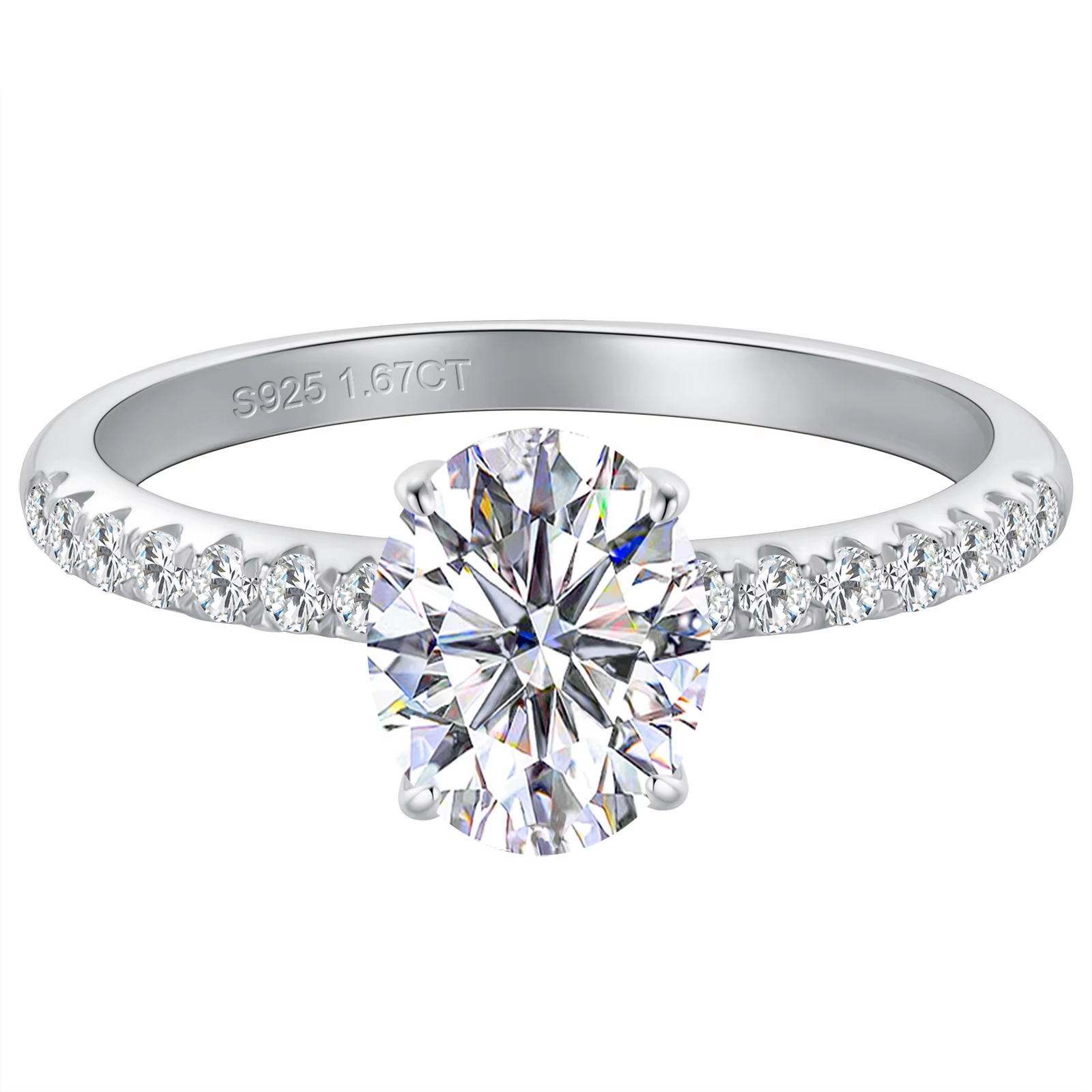
Moissanite and diamond are both hard, brilliant, colorless-when-graded-well gemstones — and that's largely where the similarity ends. Moissanite throws more fire and brilliance and costs a fraction of diamond's price; diamond is harder, has an established resale market, and carries more cultural weight, particularly for engagement rings. Neither one is a strictly "better" choice — they're built for different priorities. Here's the full comparison, without a thumb on the scale.
At a Glance
| Factor | Moissanite | Diamond |
|---|---|---|
| Hardness (Mohs) | 9.25 | 10 |
| Brilliance (refractive index) | 2.65–2.69 — higher | 2.42 |
| Fire (dispersion) | 0.104 — higher | 0.044 |
| Typical price per carat | ~$300–600 | $3,000–$15,000+ |
| Origin | Always lab-created | Mined or lab-grown |
| Resale market | Minimal | Established |
| Clarity available | VVS (eye-clean) | VVS (eye-clean) |
| Best color grade | D (colorless) | D (colorless) |
Appearance and Brilliance
This is moissanite's strongest category. Its refractive index (2.65–2.69) is meaningfully higher than diamond's (2.42), which means it bends and reflects more light back to the eye. Its dispersion — the property responsible for "fire," the rainbow-colored flashes you see when light splits inside a stone — is more than double diamond's. In practice, that means moissanite tends to look more sparkly and colorful in direct or bright light than a diamond of the same size and cut. Some people love this effect; a smaller number of traditional diamond buyers find diamond's more restrained, white-light brilliance preferable. It's genuinely a matter of taste at this point, not a case where one stone is objectively more beautiful.
Hardness and Everyday Durability
Diamond is the hardest natural material on earth, at a perfect 10 on the Mohs scale. Moissanite comes in just below it at 9.25 — still hard enough to shrug off scratches from daily wear, cooking, typing, exercising, and the general abuse an engagement ring or everyday chain takes. In practical terms, both stones will comfortably outlast the metal setting holding them; the half-point difference in hardness isn't something you'll notice in 10, 20, or 50 years of normal wear.
Price: The Biggest Practical Difference
A well-cut, eye-clean, colorless moissanite typically runs somewhere in the neighborhood of $300–$600 per carat. A diamond of comparable size, clarity, and color grade can run anywhere from $3,000 to well over $15,000 per carat, depending on the four Cs and market conditions. This gap is the reason so many buyers choose moissanite: it lets you buy a larger, higher-clarity, better-cut stone for the same budget, or the same visual impact for a fraction of the spend.
Ethics and Sourcing
All moissanite sold today is lab-created — there's no mining involved, no land disruption, and none of the sourcing complexity that has historically been a concern in parts of the mined-diamond trade (though the modern diamond industry, particularly through Kimberley Process certification and the rise of lab-grown diamonds, has made significant strides on this front too). If sourcing and environmental impact are a deciding factor for you, moissanite has a straightforward, verifiable advantage: it was grown in a lab, full stop.
Resale Value: Diamond's Real Advantage
It would be dishonest to leave this out. Diamond has a long-established secondary market — jewelers, pawn shops, and resale platforms have decades of infrastructure built around buying and reselling diamonds. Moissanite does not have an equivalent resale market; its value is almost entirely in its use as jewelry, not as a resellable asset. If you're weighing this purchase partly as a store of value, that's a legitimate point in diamond's favor, and we'd rather tell you that directly than let you find out later.
Can People Actually Tell the Difference?
For a well-cut, colorless moissanite versus a well-cut, colorless diamond, most people — including most casual observers — cannot tell them apart by eye. Jewelers and gemologists can, using tools designed specifically for the job: combined thermal-and-electrical testers (moissanite conducts electricity; diamond doesn't) and magnified inspection for moissanite's characteristic double refraction. Under a loupe or microscope, a trained eye may also notice moissanite's stronger rainbow fire in bright light as a visual tell, even without instruments.
Which One Should You Choose?
A simple way to think about it:
- Choose moissanite if you want maximum brilliance and fire, a larger or higher-clarity stone for your budget, a lab-created/zero-mining stone, or you're simply not interested in paying diamond prices for similar visual impact.
- Choose diamond if resale value matters to you, you want the hardest possible stone, or diamond's traditional role (especially for engagement rings) is important to you personally or culturally.
Both are legitimate, durable, beautiful choices — the right one depends on what you're actually optimizing for. If you're specifically weighing moissanite for an engagement ring, we go deeper on that decision in our engagement ring guide. Every moissanite piece we sell is VVS clarity, D-color, GRA certified, and hand-set in solid S925 sterling silver — see the full collection here.
Frequently Asked Questions
Common Questions
Is moissanite better than diamond?
Neither is objectively 'better' — they're different gemstones with different strengths. Moissanite has more brilliance and fire (more sparkle and rainbow flash), costs far less, and is always lab-created with no mining involved. Diamond is harder, has a more established resale market, and carries a longer cultural tradition, especially for engagement rings. Which one is 'better' depends entirely on what you're optimizing for.
Can a jeweler tell if a stone is moissanite instead of diamond?
Yes, with the right tools. Standard thermal-only diamond testers can be fooled by moissanite because it's also a strong thermal conductor, but combined thermal-and-electrical testers correctly identify moissanite because — unlike diamond — it conducts electricity. A gemologist can also spot moissanite's double refraction (birefringence) under magnification, which diamond doesn't exhibit.
Does moissanite hold its value like diamond?
No, and it's worth being upfront about this: moissanite does not have a meaningful resale or investment market the way diamond does. If resale value or diamond's role as a store of value matters to your decision, that's a real point in diamond's favor. Most people buying moissanite are doing so for its beauty, durability, and price relative to diamond — not as a financial asset.
Why is moissanite so much cheaper than diamond?
Primarily because it's lab-created at scale with a straightforward, well-understood growing process, and because it isn't subject to the mined-diamond supply chain (extraction, sorting, cutting, the traditional diamond distribution system) that adds cost at every stage. A moissanite stone typically costs a small fraction of a diamond of comparable size and visual quality.
Does moissanite look 'fake' next to a real diamond?
No — a well-cut, colorless, properly graded moissanite stone looks like a bright, brilliant gemstone, not a fake anything. The one visible difference some people notice in direct sunlight is that moissanite throws more rainbow-colored fire than diamond, which reads as more sparkly rather than fake.
Written by
Qureshi Jewelers Editorial Team
Our editorial team is made up of the same people who source, grade, and hand-set every GRA-certified moissanite stone we sell. We write from direct experience running a moissanite-focused jewelry business — inspecting stones, answering customer questions daily, and standing behind every certificate we issue.
Ready to see it in person?
Browse GRA-certified moissanite, hand-set in S925 sterling silver.