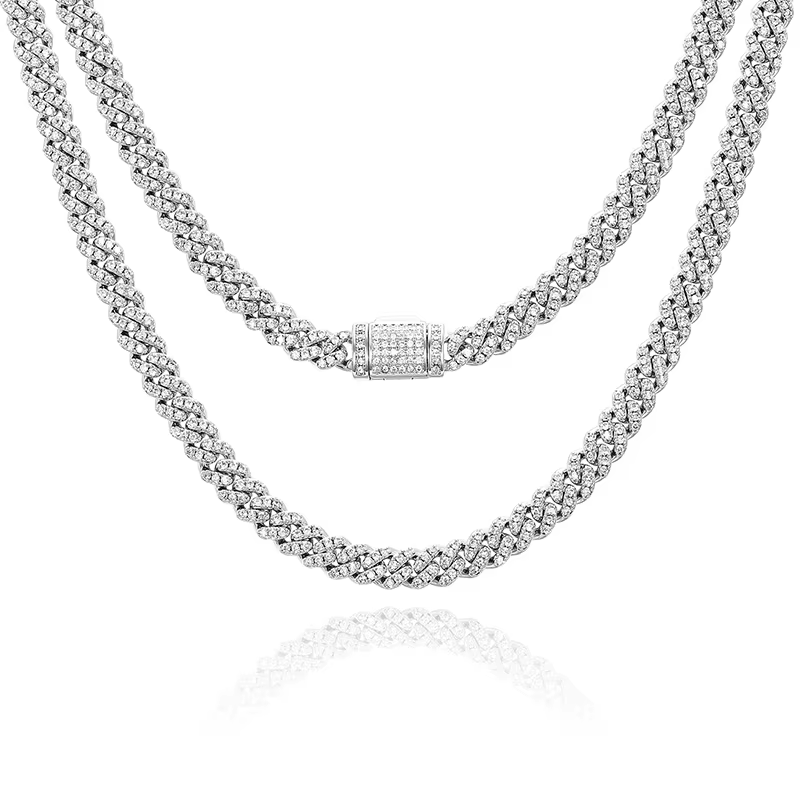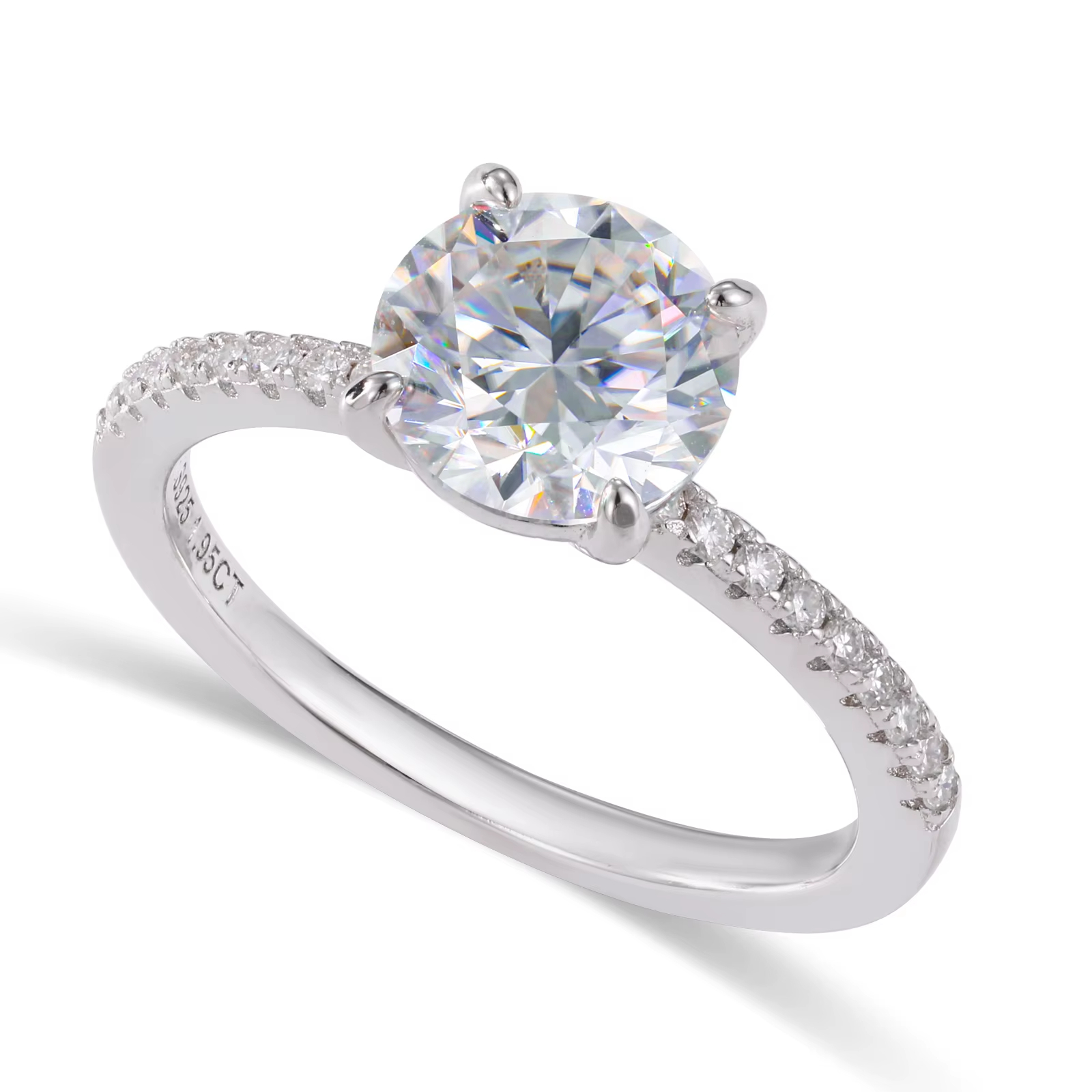
For decades, the engagement ring market operated on a single unquestioned premise: the stone must be a mined diamond. That premise is collapsing.
In 2026, a growing number of informed buyers—engineers, medical professionals, startup founders, and finance executives—are choosing moissanite. Not because they cannot afford diamonds. Because they understand the optical science, the ethical calculus, and the value equation.
Moissanite engages with higher refractive index (2.65–2.69 vs. diamond's 2.42), greater fire (0.104 vs. 0.044), and identical hardness on the Mohs scale for daily wear (9.25 vs. 10). It passes standard diamond testers. It is conflict-free, laboratory-grown, and costs 85–95 % less than a mined diamond of comparable clarity and carat weight.
This guide is the most comprehensive resource on moissanite engagement rings published in 2026. It reflects the experience of the Qureshi Jewelers team, who hand-set every stone we sell and certify each piece through the Gemological Research Association (GRA). We do not outsource grading. We do not use generic certificates. Every stone is independently verified.
Last updated: July 2026 · 14 min read
Table of Contents
- What Is Moissanite? A Gemological Overview
- Moissanite vs Diamond: The Optical & Physical Comparison
- The 4 Cs of Moissanite Engagement Rings
- VVS1 vs VS Clarity: What Actually Matters
- D Color (Colorless) vs Near-Colorless: The Visual Difference
- Cuts, Shapes & Settings: Solitaire, Halo, Three-Stone, and Beyond
- Oval Cut vs Round Brilliant: Which Should You Choose?
- Precious Metal Guide: S925 Sterling Silver, 18K Gold Plating & E-Coat Technology
- GRA Certification: Why Independent Verification Matters
- Budget Breakdown: What You Get at Every Price Point
- When to Buy: Lead Times, Proposal Timing & Custom Orders
- Frequently Asked Questions
What Is Moissanite? A Gemological Overview
Moissanite (silicon carbide — SiC) is a rare, naturally occurring mineral first discovered in 1893 by Nobel Prize-winning chemist Dr. Henri Moissan in a meteor crater in Arizona. Natural moissanite is exceptionally rare—far rarer than diamond—so virtually all moissanite used in jewelry today is laboratory-created.
This is not a "simulant." Moissanite is a genuine gemstone with its own distinct chemical composition, crystal structure, and optical properties. Unlike cubic zirconia (CZ), which is a manufactured diamond simulant with an 8.5 Mohs hardness and a tendency to cloud over time, moissanite is a durable, permanent stone that maintains its brilliance indefinitely.
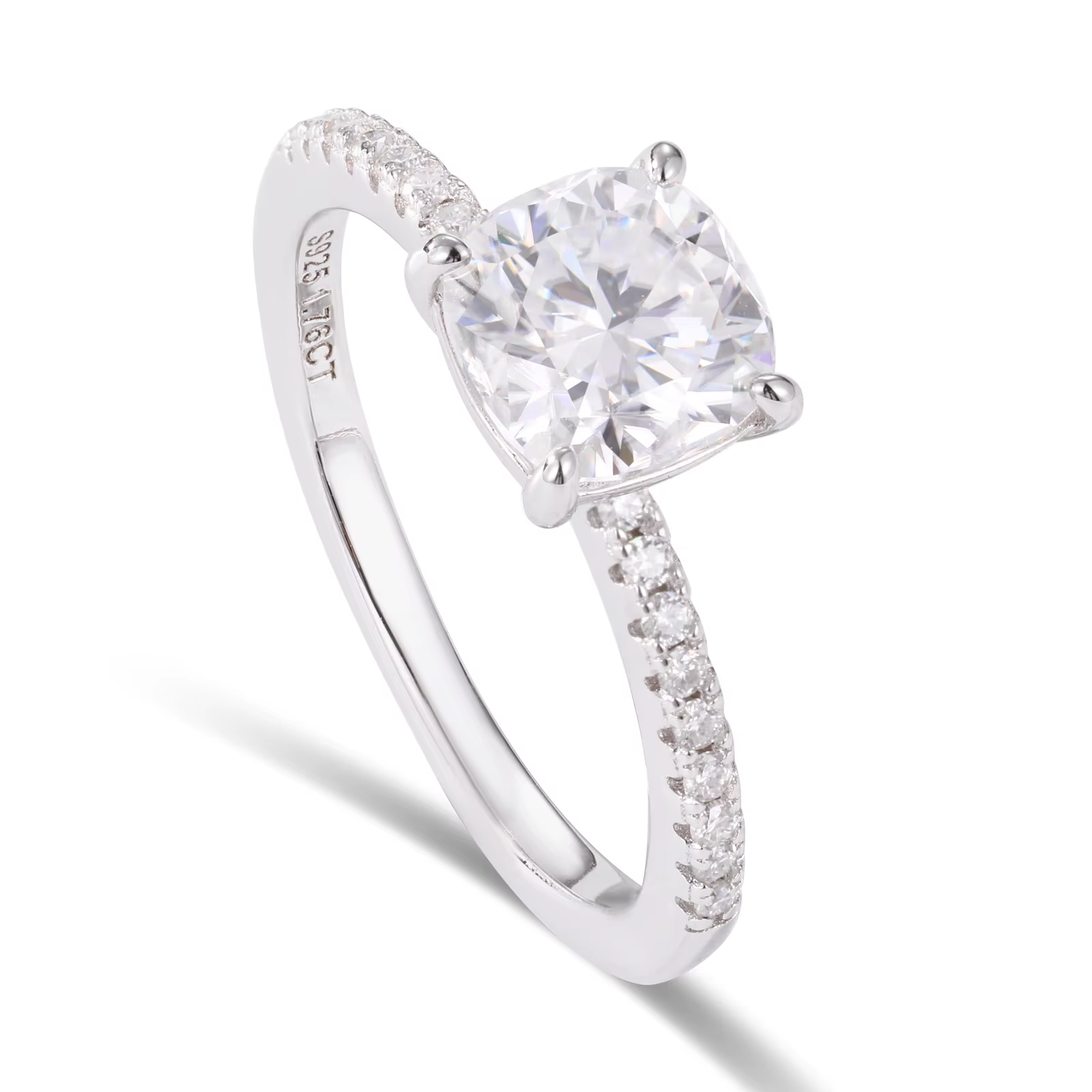
Key physical properties:
- Refractive Index: 2.65–2.69 (diamond: 2.42) — moissanite bends light more, producing greater brilliance
- Dispersion (Fire): 0.104 (diamond: 0.044) — moissanite displays roughly 2.4× more spectral fire
- Hardness: 9.25 Mohs (diamond: 10) — moissanite is the second-hardest gemstone known, durable enough for daily wear
- Specific Gravity: 3.22 (diamond: 3.52) — moissanite is slightly lighter
- Thermal Conductivity: Similar to diamond — moissanite passes standard diamond testers
Moissanite vs Diamond: The Optical & Physical Comparison
The most common question we receive is whether moissanite "looks like a diamond." The scientifically accurate answer: moissanite looks better than diamond by several objective optical metrics.
| Property | Moissanite | Diamond | Winner |
|---|---|---|---|
| Refractive Index | 2.65–2.69 | 2.42 | Moissanite |
| Dispersion (Fire) | 0.104 | 0.044 | Moissanite |
| Hardness (Mohs) | 9.25 | 10 | Diamond (negligible in daily wear) |
| Clarity (Typical) | VVS1 (virtually flawless) | VS–SI typical for mined | Moissanite |
| Color (Typical) | D–F (colorless to near-colorless) | D–Z range | Moissanite |
| Cost per Carat (1ct, D Color, VVS) | ~ $200–$500 | ~ $8,000–$15,000+ | Moissanite |
| Ethical / Conflict-Free | 100 % lab-created | Varies (mined) | Moissanite |
| Lifetime Brilliance | Permanent | Permanent | Tie |
The reality is this: from six inches away in good lighting, no untrained observer can distinguish a well-cut D-color VVS1 moissanite from a D-color VVS1 diamond. The difference is only apparent to a trained gemologist under 10× loupe magnification—and even then, it requires a specific moissanite/diamond dual tester or observation of doubling (birefringence) unique to moissanite.
The 4 Cs of Moissanite Engagement Rings
Just as with diamonds, moissanite engagement rings are evaluated on Cut, Color, Clarity, and Carat weight. However, the grading scale functions differently.
Cut
Moissanite is cut from rough silicon carbide using diamond-cutting techniques. The highest-quality moissanite is precision-cut with 57–58 facets (standard round brilliant) to maximize light return. At Qureshi Jewelers, every moissanite engagement ring uses precision-cut stones that produce hearts-and-arrows symmetry under magnification.
Color
Premium moissanite is graded D–F on the GIA color scale. D Colorless is the highest grade—completely devoid of any yellow or gray tint, even when examined under magnification. Our VVS1 moissanite engagement rings exclusively use D Colorless stones, the same grade as a top-tier D-color diamond. Browse our D Colorless moissanite engagement ring collection →
Clarity
Moissanite clarity is graded similarly to diamonds: Flawless (FL) through Included (I). The vast majority of lab-created moissanite grades at VVS1 or VVS2—"very, very slightly included"—meaning inclusions are virtually impossible to see under 10× magnification. At Qureshi Jewelers, we only stock VVS1 clarity or higher.
Carat Weight
Moissanite is lighter than diamond (specific gravity 3.22 vs. 3.52), so a 1-carat moissanite appears approximately the same size as a 1.1-carat diamond. Our engagement rings are available from 0.5ct to 3ct center stones, with 1ct and 1.5ct being the most popular choices for proposals. Shop the 1 Carat Solitaire →
VVS1 vs VS Clarity: What Actually Matters
One of the most common sources of confusion among engagement ring buyers is the difference between VVS1 and VS clarity grades. Here is the straightforward truth:
- VVS1 ("Very Very Slightly Included 1"): Inclusions are extremely difficult for a trained gemologist to locate under 10× magnification. To the naked eye, the stone is flawless. This is the grade we use for all Qureshi Jewelers moissanite.
- VS ("Very Slightly Included"): Inclusions are visible under 10× magnification but not to the naked eye.
- SI ("Slightly Included"): Inclusions may be visible to the naked eye in certain lighting conditions.
At Qureshi Jewelers, we only sell VVS1 clarity moissanite. We do this because engagement rings are purchased to mark a once-in-a-lifetime moment, and the stone should be as close to optically perfect as possible. The price difference between VVS1 and VS in moissanite is minimal—unlike diamonds, where the jump from VS to VVS1 can cost thousands.
D Color (Colorless) vs Near-Colorless: The Visual Difference
Color grading for moissanite follows the GIA D-to-Z scale. "D" is the highest possible grade—completely colorless. Stones graded E and F are also classified as "Colorless" but may exhibit trace warmth when compared side-by-side with a D.
For engagement rings, we strongly recommend D Colorless. An engagement ring is worn in all lighting conditions—direct sunlight, candlelit dinners, office fluorescents, and evening events. A D Colorless stone performs optimally across every environment, with zero detectable tint.
All Qureshi Jewelers moissanite engagement rings feature D Colorless VVS1 stones—the same grade combination that would cost $10,000+ in a mined diamond, at a fraction of that price.
Cuts, Shapes & Settings: Solitaire, Halo, Three-Stone, and Beyond
The setting you choose for your moissanite engagement ring is as important as the stone itself. Here are the most popular options:
Solitaire Setting
The classic 4-prong or 6-prong solitaire is timeless for a reason: it puts the stone front and center with no distractions. Our solitaire moissanite rings feature precision-cut center stones in a low-profile basket setting that catches light from every angle. Available from 0.5ct to 3ct.
Halo Setting
A halo of smaller moissanite stones surrounds the center stone, amplifying brilliance and making the center stone appear larger. Ideal for those who want maximum sparkle and a more contemporary aesthetic.
Three-Stone Setting
Three stones side by side—traditionally representing the past, present, and future. This setting offers a distinctive vintage-inspired look with exceptional finger coverage.
Oval Cut
The oval cut has surged in popularity over the past three years, and for good reason. The elongated silhouette creates a flattering slimming effect on the finger, and the mixed-cut facet pattern produces exceptional brilliance. Our oval moissanite engagement rings are among our most requested pieces.
Oval Cut vs Round Brilliant: Which Should You Choose?
This is the most common debate among engagement ring shoppers. Here is our guidance based on thousands of customer consultations:
| Factor | Round Brilliant | Oval Cut |
|---|---|---|
| Brilliance (Light Return) | Maximum — the most optically efficient cut | Very High — mixed cut produces excellent brilliance |
| Finger Coverage | Standard | Appears larger per carat due to elongated shape |
| Finger Slimming Effect | Neutral | Yes — the elongated shape creates a flattering optical illusion |
| Vintage Appeal | Classic / Timeless | Modern / Trending |
| Setting Compatibility | Universal — works with any setting | Best in solitaire, halo, or three-stone |
Our recommendation: If you want the absolute maximum brilliance and a timeless look that will never go out of style, choose a round brilliant solitaire. If you want a modern, distinctive look with greater perceived finger coverage, choose an oval cut.
Precious Metal Guide: S925 Sterling Silver, 18K Gold Plating & E-Coat Technology
Every Qureshi Jewelers engagement ring is built on a foundation of solid S925 sterling silver (92.5 % pure silver), not brass, copper, or base metal alloys. This matters because:
- Hypoallergenic: S925 sterling silver is lead-free, nickel-free, and cadmium-free—safe for sensitive skin
- Durability: Sterling silver is significantly harder and more durable than gold alloys at equivalent karat weights
- Integrity: Solid construction, not hollow or plated base metal
Over the sterling silver core, we apply 5× 18K precious metal plating (yellow gold, rose gold, or white gold/rhodium) using an advanced multi-layer electroplating process. Each layer is individually applied and sealed with our proprietary e-coating technology, which creates a tarnish-resistant, water-resistant barrier that prevents the plating from wearing away.
The result is a finish that is visually indistinguishable from solid 18K gold but at a fraction of the price—and more durable than solid gold due to the combination of the hard S925 core and the protective e-coat layer.
GRA Certification: Why Independent Verification Matters
Every Qureshi Jewelers moissanite engagement ring ships with a GRA (Gemological Research Association) Certificate of Authenticity. This is not a marketing handout—it is an independently issued document that specifies:
- Stone type: Lab-created moissanite (silicon carbide)
- Clarity grade: VVS1
- Color grade: D (Colorless)
- Carat weight
- Cut grade
- Unique certificate number (traceable)
We require GRA certification for every piece we sell because trust is the foundation of our business. When you purchase from Qureshi Jewelers, you receive exactly what is advertised—a D Colorless VVS1 moissanite, independently verified, with documentation you can use for insurance purposes.
Budget Breakdown: What You Get at Every Price Point
| Budget | Center Stone | Setting | Metal | Example |
|---|---|---|---|---|
| $149–$249 | 0.5ct VVS1 D Colorless | 4-Prong Solitaire | S925 + 5× 18K Plating | 0.5ct Solitaire |
| $299–$499 | 1ct VVS1 D Colorless | 4-Prong Solitaire | S925 + 5× 18K Plating | 1ct Solitaire |
| $500–$799 | 1.5ct VVS1 D Colorless | Solitaire or Oval | S925 + 5× 18K Plating | 1.5ct Solitaire |
| $800–$1,200 | 2ct VVS1 D Colorless | Solitaire or Oval | S925 + 5× 18K Plating | 2ct Solitaire |
| $1,200+ | 3ct VVS1 D Colorless | Solitaire or Custom | S925 + 5× 18K Plating | 3ct Solitaire |
Compare this to a mined diamond engagement ring, where a 1ct D-color VVS1 diamond in a comparable setting would cost $8,000–$15,000. The value difference is not incremental—it is transformative.
When to Buy: Lead Times, Proposal Timing & Custom Orders
Standard moissanite engagement rings from Qureshi Jewelers ship within 1–3 business days. Custom orders (specific stone sizes, unique settings, or non-standard ring sizes) typically require 5–10 business days.
We recommend ordering at least 2–3 weeks before your planned proposal date to allow for shipping, inspection, and any resizing needs. Express shipping is available for last-minute proposals.
Every ring is hand-set and inspected by our team before shipment. We inspect each stone for centering, each prong for secure placement, and each band for flawless plating finish.
Frequently Asked Questions
Is moissanite a "fake diamond"?
No. Moissanite is a genuine gemstone with its own chemical composition (silicon carbide), crystal structure, and optical properties. It is not a diamond simulant like cubic zirconia. It is a real, durable, permanent gemstone that passes standard diamond testers.
Does moissanite lose its sparkle over time?
No. Moissanite has permanent brilliance. It does not cloud, fade, or degrade. Because moissanite is 9.25 on the Mohs hardness scale, it resists scratching and maintains its polish indefinitely.
Can you tell the difference between moissanite and diamond?
To the untrained eye, a well-cut D-color VVS1 moissanite is visually indistinguishable from a D-color VVS1 diamond. The difference is only detectable by a trained gemologist using specialized equipment (dual tester or 10× loupe to observe birefringence).
Is moissanite engagement ring durable for daily wear?
Yes. At 9.25 Mohs hardness, moissanite is the second-hardest gemstone known, surpassed only by diamond (10). It is suitable for daily wear, including professional environments, active lifestyles, and travel.
What is the best moissanite engagement ring for the price?
The best value is a 1ct D Colorless VVS1 solitaire moissanite ring in 18K gold-plated S925 sterling silver. At roughly $300–$500, it delivers optical performance comparable to a $10,000+ diamond engagement ring.
Does moissanite come with a certificate?
Yes. Every Qureshi Jewelers moissanite engagement ring ships with an independent GRA (Gemological Research Association) Certificate of Authenticity that specifies the stone's clarity (VVS1), color (D), carat weight, and cut grade.
Can you propose with a moissanite ring and upgrade later?
Absolutely. Many of our customers propose with a moissanite engagement ring and later add a matching moissanite wedding band or upgrade to a larger stone. The lifetime value and durability of moissanite make it an excellent "forever" stone.
How should I clean my moissanite engagement ring?
Clean your moissanite ring with warm water, mild dish soap, and a soft toothbrush. Avoid ultrasonic cleaners if your ring has e-coating (though brief ultrasonic use is generally safe). For a deeper clean, use a jewelry polishing cloth designed for precious metals.
This guide was written by the Qureshi Jewelers Editorial Team, a group of gemology and precious metals specialists who collectively grade, hand-set, and certify every moissanite piece we sell. Our recommendations are based on real-world experience working with thousands of customers and tens of thousands of stones. We do not accept compensation for product reviews or endorsements. Every opinion expressed in this guide reflects our genuine expertise and commitment to transparency.
Ready to explore? Shop all moissanite engagement rings →
Frequently Asked Questions
Common Questions
Is moissanite a fake diamond?
No. Moissanite is a genuine gemstone with its own chemical composition (silicon carbide), crystal structure, and optical properties. It is not a simulant like cubic zirconia. Moissanite passes standard diamond testers and is the second-hardest gemstone on Earth at 9.25 Mohs.
Does moissanite lose its sparkle over time?
No — moissanite has permanent brilliance. It does not cloud, fade, or degrade. Because moissanite is 9.25 Mohs hardness, it resists scratching and maintains its polish indefinitely, making it an excellent lifetime gemstone for engagement rings.
Can you tell the difference between moissanite and diamond?
To the untrained eye, a well-cut D-color VVS1 moissanite is visually indistinguishable from a D-color VVS1 diamond. The difference is only detectable by a trained gemologist using a dual tester or 10x loupe to observe birefringence — moissanite is doubly refractive while diamond is singly refractive.
What is the best moissanite engagement ring for the price?
The best value is a 1ct D Colorless VVS1 solitaire moissanite ring in 18K gold-plated S925 sterling silver, available at Qureshi Jewelers for approximately $300–$500. This delivers optical performance comparable to a $10,000+ diamond engagement ring.
Does moissanite come with a certificate?
Yes. Every Qureshi Jewelers moissanite engagement ring ships with an independent GRA (Gemological Research Association) Certificate of Authenticity that specifies clarity (VVS1), color D, carat weight, and cut grade.
Is moissanite engagement ring durable for daily wear?
Yes — at 9.25 Mohs hardness, moissanite is the second-hardest gemstone known, surpassed only by diamond. It is suitable for daily wear in all environments, including professional settings, active lifestyles, and international travel.
How much does a moissanite engagement ring cost?
Qureshi Jewelers moissanite engagement rings range from $149 (0.5ct solitaire) to $1,200+ (3ct solitaire), all with D Colorless VVS1 stones, GRA certification, and hand-set S925 sterling silver with 5x 18K gold plating.
Can you propose with a moissanite ring and upgrade later?
Yes — many customers propose with a moissanite engagement ring and later add a matching wedding band or upgrade to a larger stone. Moissanite is a durable, permanent gemstone that serves beautifully as a lifelong engagement ring.
How should I clean my moissanite engagement ring?
Clean with warm water, mild dish soap, and a soft toothbrush. Avoid ultrasonic cleaners if your ring has e-coating. Use a jewelry polishing cloth for precious metal maintenance. The stone itself is scratch-resistant and will not cloud.
What is GRA certification?
GRA (Gemological Research Association) certification is an independent, third-party verification of a moissanite stone’s clarity grade, color grade, carat weight, and cut quality. Every Qureshi Jewelers piece ships with a GRA certificate that can be used for insurance purposes.
Written by
Qureshi Jewelers Editorial Team
The Qureshi Jewelers team sources, independently grades, and hand-sets every GRA-certified moissanite stone we sell. With thousands of pieces curated for discerning customers worldwide, our collective expertise spans gemology, precious metal fabrication, e-coat plating technology, and fine jewelry craftsmanship. Every guide we publish reflects the same standards we apply to every order: precision, transparency, and an unwavering commitment to quality.
Ready to see it in person?
Browse GRA-certified moissanite, hand-set in S925 sterling silver.